





2026-09-15
William Li Invited to Speak at WTO World Trade and Tech Day
September 14, 2026, Geneva - William Li, NIO’s Founder, Chairman, and CEO, was invited to attend World Trade and Tech Day at the World Trade Organization (WTO) headquarters in Geneva, where he delivered a keynote speech. Held under the theme “AI and Trade: Turning Potential into Progress,” this year’s event brought together representatives from international organizations, governments, and industries around the world to explore the opportunities and challenges for global trade in the AI era.
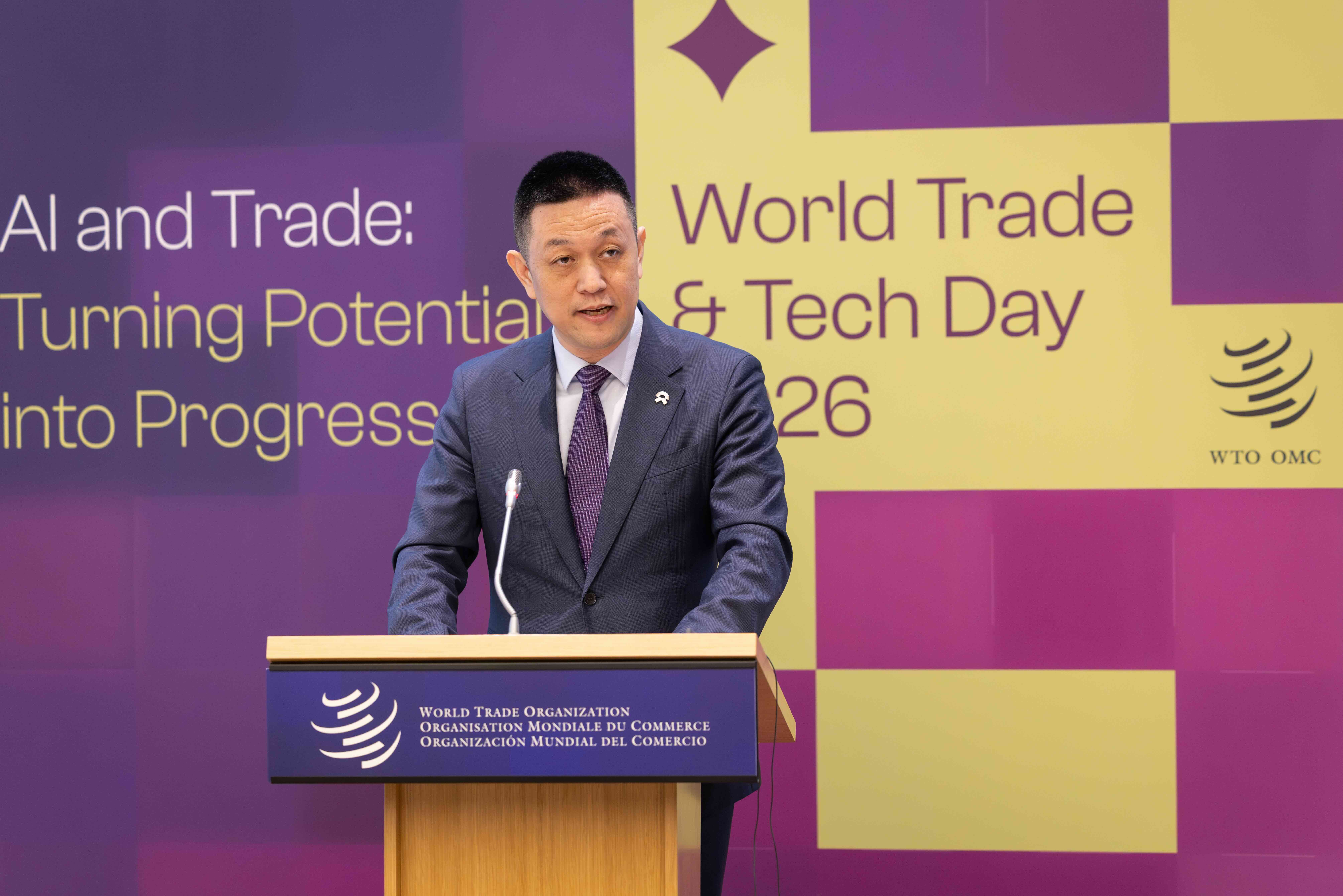
With AI developing at incredible speed, a new challenge arises for policymakers across the globe: How to encourage innovation while making sure AI is safe, trustworthy, and responsibly deployed? The automotive industry can offer a real-world perspective on this question, as it is one of the world’s most globalized industries and an industry where safety is critical.
According to William, as electrification, smart technologies, and AI come together, smart EVs have already become the most widely used physical AI agents today. And that means no automaker will lead the future without leading in AI.
One of the clearest examples is autonomous driving. It brings together AI, software, hardware, and the car itself. Ten years ago, NIO set a goal for autonomous driving: to relieve stress and reduce accidents. Today, NIO’s smart driving system, built on an architecture that combines a world model with full closed-loop reinforcement learning, has already been deployed in more than 950,000 vehicles. So far, NIO’s smart driving system has accumulated more than 7.7 billion kilometers and 98 million hours of driving, helping to mitigate or avoid 8.35 million potential accidents for our users. Our internal data also shows that the average safe mileage of human-AI co-driving is 8 times that of human-only driving.
Across the globe, traffic safety is still a critical social issue. In 2025, around 1.16 million people lost their lives in road accidents around the world. And every day, more than 1 billion people spend roughly 70 minutes on average commuting by road. These numbers remind us that safer and smarter mobility is not just a technology issue. It is a social issue. If technologies like smart driving can be made trustworthy and widely used, they can make driving less stressful, help prevent accidents, and improve everyday mobility for billions of people. The potential impact goes far beyond the car itself.
The global development and deployment of smart driving requires global coordination. Road conditions, traffic rules, data requirements, safety standards, and market access rules can all vary between countries and regions. At the same time, AI systems need to perform safely and consistently across different environments. This requires automakers to consider global regulatory compliance and local market adaptation from the early stages of product development, with targeted testing and validation conducted for different environments to ensure safe and consistent system operation.
William saw a fundamental question for the automakers: How can they bring new technologies to different markets safely, efficiently, and in compliance with local requirements? This requires all stakeholders to work toward greater consistency in testing methods and mutual recognition of test results, which can significantly reduce the costs of deploying new technologies in overseas markets. The core of international conversation is not to make every market the same, but to build common ground where possible, so that innovation can move more freely without compromising safety.
As the global trade environment becomes increasingly complex, differences in regional regulations are raising the barriers to the large-scale deployment of frontier technologies. The right rules do not have to slow innovation down. They should build trust, reduce barriers, support innovation, and allow technology, talent, and trade to create greater value across borders.
Under the WTO framework, we hope to see more dialogue, more common ground, and more workable rules. Ultimately, this can create new opportunities for global trade, and contribute to a sustainable and brighter future together.
About NIO
NIO is a global smart electric vehicle company founded in November 2014. Dedicated to shaping a sustainable and brighter future together by providing high-performance smart electric vehicles and exceptional user experiences, NIO is the first car company listed on the NYSE, HKEX and SGX. NIO currently has three major brands under its umbrella: NIO, ONVO and firefly.
Ten years into establishment, NIO is now one of the leading companies in the global premium smart electric vehicle market, committed to fostering its own research and development capabilities for core technologies, the company had filed for and obtained over 13,000 patents. Additionally, NIO has developed NIO Full Stack, a collection of 12 technology domains.
Currently, NIO has R&D centers and manufacturing facilities in over 10 locations, including Shanghai, Hefei, Beijing, Nanjing, San Jose, Munich, Oxford, Budapest, Singapore, and Abu Dhabi. Additionally, it has built a sales and service network across 24 countries and regions, including China, Europe, the Middle East, Central Asia, Southeast Asia, and Central America.
NIO Inc. currently offers eight premium smart electric vehicle models under the NIO brand, two smart electric vehicle under the ONVO brand and one small, smart, high-end electric vehicle under firefly brand. As of July 31, 2026, NIO Inc.’s cumulative deliveries reached 1,224,649 vehicles, reinforcing its position as a leader in advancing technological innovation and premium brand development in China’s smart EV industry.
